


Managing Personal Change: How Resilient Are You?
“It is not the strongest of the species that survives, nor the most intelligent,but the one most responsive to change.”
– Charles Darwin (1809-1882), English naturalist and geologist, best known for his contributions to evolutionary theory
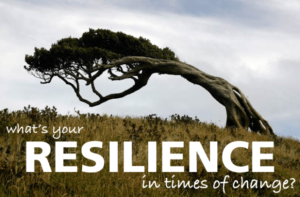 Individual Resilience is how humans adapt to change. It’s like a tree in a storm: some trees (like a live oak) bounce back from the force of the wind, looking like nothing has happened. Other trees (like a pine tree) aren’t so flexible, and after constant winds branches break or the tree stays bent. People are like that too: some bend in times of change and snap back while others break, get damaged, or never fully recover.
While there’s a lot of conversation in the “change management” circles about the process of change, you don’t hear enough about how to set people up for success when change occurs, or how to help them be resilient, ready for the winds of change. But there’s a lot of great research out there on how us humans react to change from a variety of fields; let’s explore just one of these ideas on resilience.
Change Management researchers Dr. Linda Hoopes and Mark Kelly looked at over thirty years’ worth of change management data and identified the key variables that make individuals successful in times of change. They looked at why Person A thrived and grew in times of change and why Person B crashed and burned in the same time. They found that the people who thrived and grew had high competence in seven specific areas, and they dubbed these the 7 Aspects of Individual Resilience. In theory the higher we are in these seven areas the better we are at surviving — and thriving — in times of change.
“Doing the Right Thing … When No One is Looking”
 “Integrity” is one of those words that’s thrown out in organizational cultures, but what’s it really mean, and is it really followed? We’ve worked with many orgs where “integrity” was one of those values on fancy posters hanging around the office. But, as we venture further into 2017, let’s ask ourselves if we ARE indeed working with “integrity?”
An often used definition of “integrity” is the C.S. Lewis quote: ” ‘Integrity’ is doing the right thing when no one is watching.” It’s a succinct way of explaining the concept. People often additionally define “integrity” with words like “honesty,” “truthfulness,” and “fairness.” However, integrity is much more than that: it’s the core operating system with which we live, how we often wish to run our organizations, and what people expect in their leaders.
Many folks (and frankly organizations) wish to improve or focus on developing their individual and collective integrity. How can you do this? Like keeping a New Year’s resolution (we shared strategies for this in this post), building our individual integrity is all about practice.
Here are six strategies that may help you build your leadership integrity:
The “Year of the Dog” and Sticky Resolutions
 The turning of the year is a time when many people think about what they’d like to accomplish in the upcoming shiny new year. While I, too, do believe that January is a perfect time to identify where I’d like to go (in this case) in 2017, but I find it equally beneficial to also think about WHAT goals I set out for myself last year, and how well did I meet them and — if I didn’t — why?
I saw a cartoon once that had two cows sitting in a pasture. One cow asked the other, “What are resolutions?” The other cow replied, “It’s a human’s ‘To Do’ list for the first week in January.” This always stuck with me, as so many folks make New Year’s resolutions … and then either break them or forget about them a short time into the New Year.
So, how can we make our resolutions “stick”? There’s a lot of great research on how we humans can keep our willpower and dedication to keep our goals. Here’s some suggestions: (more…)